
Inspection Machine Automation
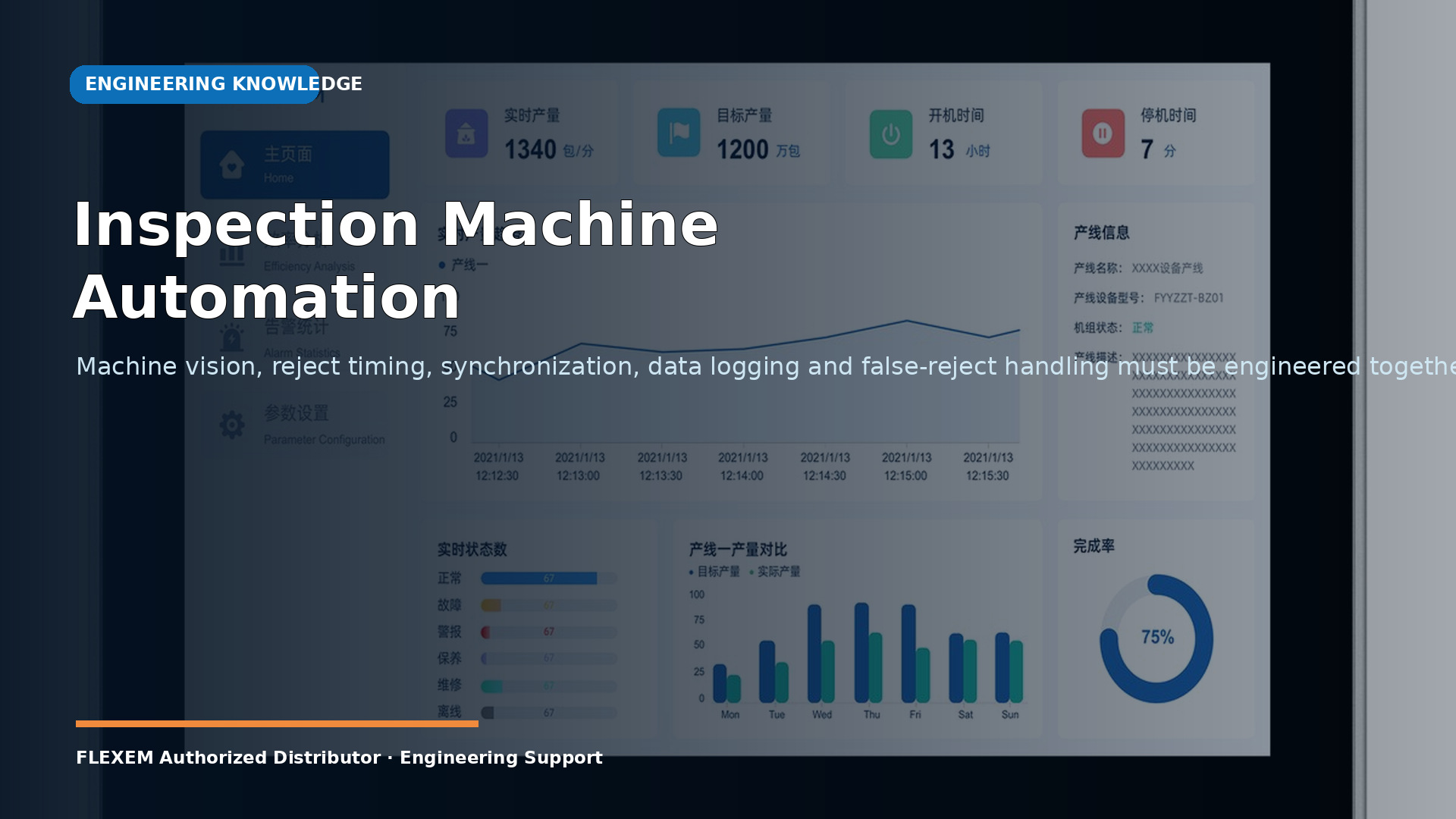
Machine vision, reject timing, synchronization, data logging and false-reject handling must be engineered together.
Engineering decision first
Machine vision, reject timing, synchronization, data logging and false-reject handling must be engineered together. For an OEM machine builder, the correct choice is the one that reduces integration risk, keeps commissioning measurable and leaves maintenance engineers with a system they can diagnose.
What to document before selection
- Machine process, cycle time and operating modes
- Current controller / HMI / drive and complete model suffix
- Power, I/O, communication and mechanical interfaces
- Failure behavior, recovery and maintenance requirements
- Quantity, destination, documentation and certification needs
Recommended workflow
- Capture the installed or proposed architecture.
- Mark interfaces that cannot change without redesign.
- Separate mandatory functions from optional functions.
- Verify candidate hardware and software against those interfaces.
- Bench-test high-risk functions before machine commissioning.
- Prepare backup and rollback before changing a production machine.
Common failure modes
Most problems come from treating one headline specification as proof of compatibility. In practice, mounting, network behavior, firmware/software revision, cable pinout, scaling, state logic and commissioning procedures can all change the result.
FLEXEM selection boundary
Trompeter-Tech can recommend a FLEXEM product direction after reviewing the real machine information. Final ordering code and compatibility should be confirmed against the latest official FLEXEM documentation.
RFQ checklist
- Complete model / nameplate photo
- PLC or controller model
- Protocol and network details
- Machine application and motion/process requirement
- Quantity and destination